
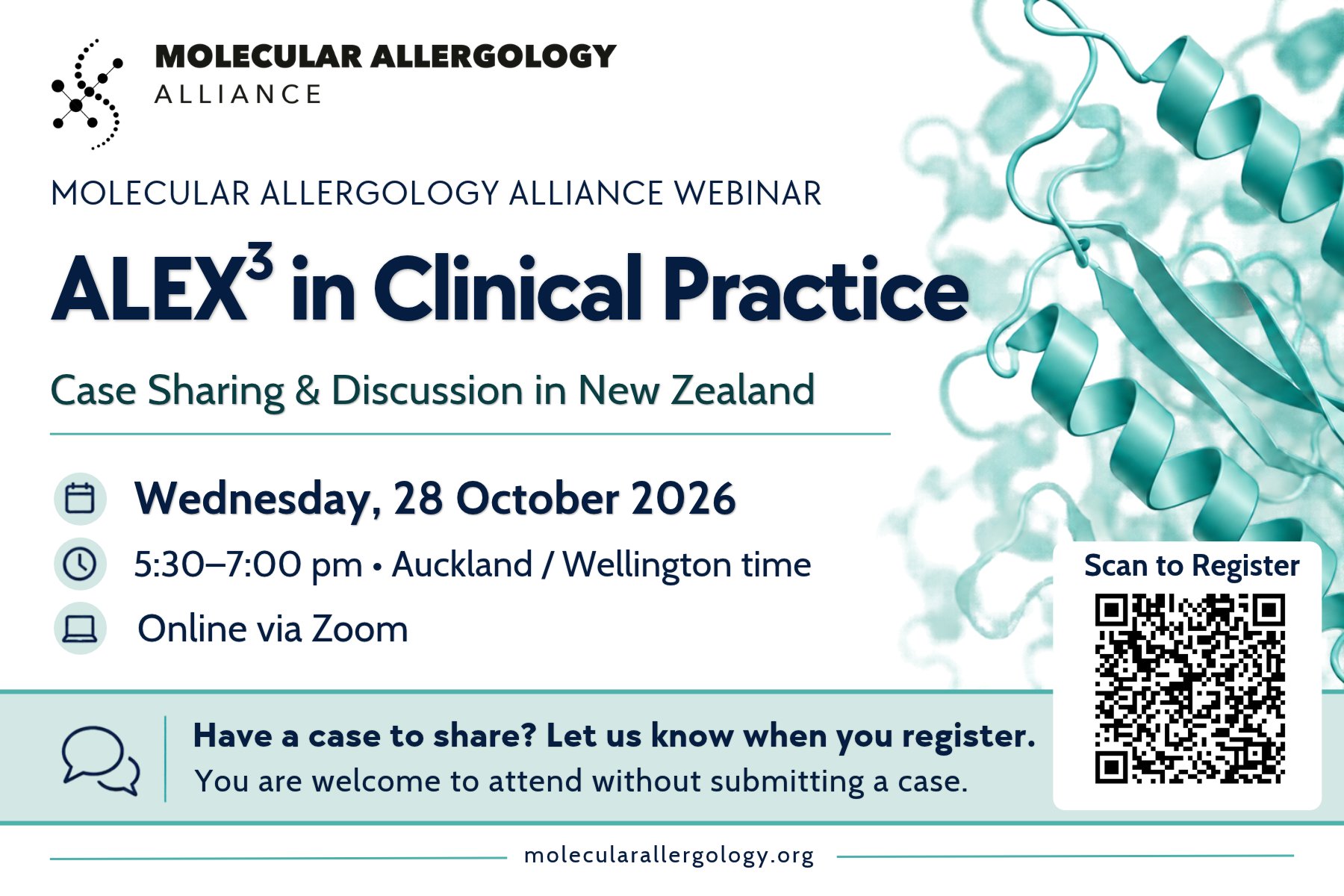
On 28 October 2026, Molecular Allergy Alliance (MAA) held its New Zealand webinar, ALEX³ in Clinical Practice, co-hosted by Dr Marci Chai and Dr Richard Steele. The programme moved from the foundations of molecular allergology to New Zealand laboratory experience, followed by contributions from Dr Michael Becker and Dr Anna Gilmour. Discussion with colleagues overseas also brought regional differences in allergy into focus.
Reading results in context
Dr Chai opened with the distinction between sensitisation and clinical allergy. Her introduction covered allergen extracts, individual molecular components and cross-reactivity, showing why several positive results can share an explanation. Protein families provided a way to understand these patterns, while the comparison of singleplex and multiplex testing returned to the clinical question being asked.
The central message was that a more detailed report still needs the patient’s history: symptoms, exposures, timing and foods tolerated on other occasions all contribute to interpretation.
Molecular testing in the New Zealand setting
Dr Steele examined limitations of whole-allergen extracts, including variation in their composition and the challenge of representing relevant allergens across different regions. He then described the introduction of ALEX³ at Awanui’s Wellington laboratory and presented early verification experience.
That work was organised around practical questions: clarifying suspected allergies and possible hidden triggers, reassessing existing allergy labels, and reviewing the focus of allergen immunotherapy. The examples also showed how additional findings could lead to further assessment and new questions.
New Zealand’s allergen environment was a substantial part of the presentation. Dr Steele discussed pollens beyond those routinely tested, possible lipid transfer protein (LTP) patterns, and the need to consider both local exposures and sensitisation acquired before migration. Further verification after the platform’s introduction was identified as a next step.
Choosing when more information may help
Dr Becker brought the discussion back to clinical judgement. Drawing on unresolved presentations from his practice, he described situations in which he was considering additional testing: an unexpected lack of response to immunotherapy, a mismatch between symptoms and conventional results, and food reactions with uncertain triggers. These were questions for investigation, with the value of testing still to be established in the individual cases.
An audience contribution from Singapore extended the discussion to migration: how sensitisation patterns may evolve after moving countries, how changing symptoms relate to new exposures, and when reassessment might be useful. Participants shared their clinical experience without establishing a single testing interval.
Working through competing explanations
Dr Gilmour presented a complex case for peer discussion, focusing on how to interpret several sensitisation patterns when the cause of recurrent reactions remained uncertain. Questions included the relevance of storage mites and moulds, serum-albumin cross-reactivity involving cat and pork, and fungal sensitisation in the context of respiratory and skin disease.
The exchange illustrated the work that follows a molecular report: comparing possible explanations with the history, examining foods tolerated between episodes and identifying what remains unresolved. Contributors acknowledged uncertainty about mite cross-reactivity and the clinical meaning of particular findings. The discussion also touched on affordability and access to immunotherapy.
Continuing the discussion
In closing, Dr Chai invited feedback on an ALEX³ clinician guide and described a questionnaire intended to support patient selection and interpretation. These were presented as tools for further review and development. Dr Steele welcomed continued case sharing with New Zealand and overseas colleagues.
MAA will explore selected clinical topics from the webinar in future articles, allowing more space for the questions and interpretation challenges raised during the session.