
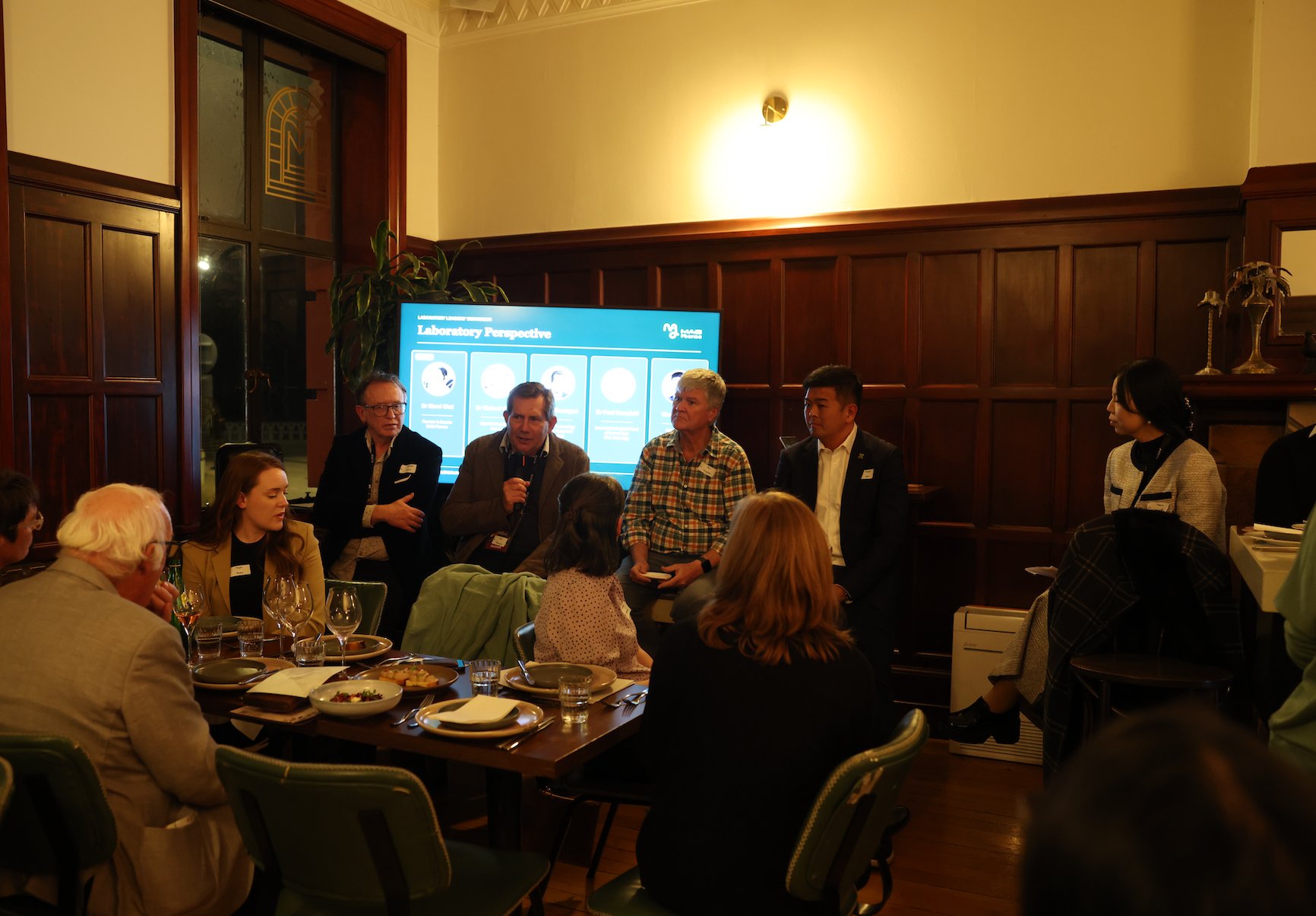
On 1 September 2026, the evening before ASCIA 2026 opened, we welcomed allergy specialists, laboratory experts and research leaders to the Molecular Allergology Drinks & Dinner at MIRO, a MICHELIN-recognised restaurant in Christchurch. The setting gave colleagues from Australia and New Zealand time to enjoy an exceptional meal while exchanging practical views on allergen components, multiplex testing and the interpretation of complex IgE profiles.
The evening was co-hosted by Dr Richard Steele, Chief Medical Officer at Awanui Labs, and Dr Karl Baumgart, Director of Immunology at DHM Pathology. Dr Christian Lupinek opened the scientific programme with a presentation on ALEX3 and molecular allergology. All three joined the dinner and the wider panel discussion.
Event details
MIRO | 176 Oxford Terrace, Christchurch Central City, Christchurch 8011, New Zealand
Tuesday 1 September 2026 |5.30 pm to 9.30 pm New Zealand time
Three Perspectives One Table
The panel brought laboratory, clinical and research perspectives to one table. The discussion was designed to communicate scientific evidence, demonstrate clinical value and foster collaboration.
Laboratory perspective Dr Karl Baumgart, Dr Richard Steele, Dr Paul Campbell and Mr Vincent Chen
Clinical perspective Professor Jo Douglass, Dr Vincent Crump, Dr Ignatius Chua, Dr Anna Gilmour and Dr Christian Lupinek
Research perspective Professor Sheryl van Nunen, Professor Janet Davies, Professor Andreas Ludwig Lopata, Associate Professor Alice Lee and Dr Eszter Sarzsinszky
Programme
- 5.30 pm Welcome drinks and registration
- 6.10 pm Dr Christian Lupinek ALEX3 and Molecular Allergology
- 6.40 pm Entrée and laboratory perspective
- 7.15 pm Main course and clinician perspective
- 8.05 pm Dessert and research perspective
- 8.50 pm Open Q&A and Networking
- 9.15 pm Closing remarks and informal networking
Across the programme, one question ran through the evening: when a test reports sensitisation, how do we decide whether the result explains the patient’s symptoms?
From positive results to molecular explanations
Extract based testing remains an important part of allergy diagnosis, but extracts can vary in composition and allergen concentration. Clinically relevant molecules may be underrepresented. Der p 23, for example, may occur at low levels in some house dust mite extracts. At the same time, IgE to shared protein families or carbohydrate structures can produce positive results across several apparently unrelated allergen sources.
Molecular allergology provides greater resolution by identifying the specific allergen molecules recognised by a patient’s IgE. When interpreted alongside the clinical history, these results can help clinicians consider whether a finding represents primary sensitisation, cross sensitisation or an in vitro signal with limited clinical relevance.
Different backgrounds can produce different sensitisation patterns
Australia and Aotearoa New Zealand have highly diverse populations. A patient’s childhood environment, migration history and current exposures can all shape an IgE profile. The same presentation may therefore have a different molecular basis in two patients.
Peanut sensitisation may be dominated by the storage protein Ara h 2 in some populations, while the lipid transfer protein Ara h 9 may be more relevant in Mediterranean settings. Patients from tropical regions may show sensitisation to Blomia tropicalis as well as Dermatophagoides mites. Pollen patterns also vary across regions, and migration can add new exposures to an existing sensitisation profile.
These examples reinforced the value of taking a geographic and dietary history before interpreting a broad allergen array.
Cases brought the science back to patient care
The most engaging conversations began with real cases. Participants discussed food allergy, pollen food syndromes, immunotherapy that had produced an incomplete response, and patients with extensive avoidance diets after multiple positive tests.
A preliminary review of 17 complex allergy patients illustrated the range of questions that molecular testing can help address. The profiles supported some established diagnoses, including egg allergy and sensitisation to peanut or tree nut storage proteins. They also identified signals that required further clinical assessment, including kiwifruit, non specific lipid transfer proteins, Malassezia and previously unrecognised pollen sensitisation.
Negative component results also helped clinicians reconsider some labels involving soy, coconut, latex, shellfish and house dust mite. A negative result did not remove the need for clinical assessment, but it changed the next conversation. In selected cases, it supported consideration of supervised reintroduction, challenge testing or a review of previous immunotherapy choices.
A shared approach to better interpretation
The evening closed with a practical point. Molecular testing adds value when it helps clinicians ask more precise questions. It does not replace the history, examination or challenge testing. The complete picture emerges when clinical evidence and laboratory findings are interpreted together.
Thank you to every panel member and colleague who contributed a case, challenged an interpretation or shared experience from clinical practice. Before the formal ASCIA programme began, the dinner had already opened a thoughtful conversation about how molecular allergology can support more individualised care.